1905 -- To Mount Gambier and Portland, Victoria.
25 October 1905 -- Henry Tilbrook again travelled to Mount Gambier by train. By now he had developed heart troubles, but refused to let this interfere with his desire to travel and take photographs.
‘Having by this time developed serious heart dilation I was not very certain of myself. So, on my journey to the Mount by train I refrained from eating anything. Marianne was anxious about me, as I had been seriously ill with heart failure. Having previously collapsed while in the train between Adelaide and Gawler I was careful of myself this time.
‘At Mount Gambier my friend Fred Lester was awaiting me. His residence was now over the new two-storey offices of the A.M.P. Society. It was at his instance that the Society bought the land near the P.O. and erected the building at a total cost of two thousand pounds. Mrs Lester's drawing-room upstairs was said to be the largest and finest in Mount Gambier. There three grades of society at Mount Gambier -- the Ice Creams, the Jam Tarts, and the Suet Dumplings. Needless to say my hostess belonged to the Ice Creams, and her splendid residence was in keeping with her position as a leader of society.’
On this excursion Henry and Fred Lester took with them a Mr Olsen who was the clerk of the Mount Gambier Local Court. It was late in the afternoon when they left for the township of Nelson, bitterly cold and windy. At one point his two mates stopped to shoot at some kangaroos. ‘They then requested the use of my umbrella to light their pipes. It was packed caefully at the back of the seat, as I used it only with the camera. Having lit their pipes and returned it to me, I placed it carelessly against the front dashboard. When I put my hand down to get it a few miles further on, it was gone! And forever, for we could not turn back. It soon got pitch dark and we could see nothing. At ten p.m. we came to a sudden stop on the bank of the Glenelg River. It was so dark the horses were invisible from the trap. The Nelson lights were on the other side of the bridge and river.’
They picked their way carefully along the track to a camping ground. Henry went ahead with a piece of white cloth on his back and Lester drove the horses with their heads close to Henry's back using the white cloth as a guide. ‘At ten-thirty p.m. we erected our high, pointed, military tent, doomed later to partial destruction in a hurricane.’
The next day ‘we hired a rowing boat, and I accompanied my two friends in it to the mouth of the river. They were intent upon fishing, I was after views. Owing to the rain I could take only one view, a stereoscopic.’ The weather deteriorated and in a raging storm they had to pack up their camp and move into the hotel at Nelson. Henry managed to ‘change plates for the morrow’ before going to bed.
‘I was up and out with my camera before the others were awake. I had borrowed the landlady's parasol and when I had taken the views I returned it to her. The morning was calm and the rain over. I took several panoramic views of the mouth of the Glenelg River.’
The party of three left for Portland, and on the way Henry remembered his doctor’s warnings about strenuous exercise, although he had ignored them earlier when he waded through boggy ground carrying his thirty eight pound load of cameras. ‘I suddenly began to think of my doctor’s warnings - not to take violent exercise, or even go up steps, or carry heavy weights, or go up hills.’ On many occasions Henry failed to follow his doctor’s advice. He was now 57 years old.
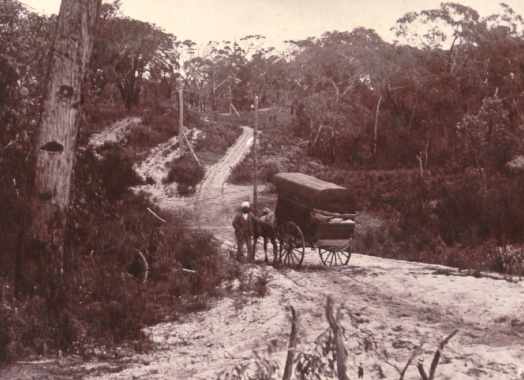
They camped at Johnson’s Creek, between Portland and Nelson -- ‘Our stay here was to be limited to one day which, however, gave me ample time to do some exploring and take photographic views. I went solus to Johnson’s Creek to take a photo. My mates went hunting, but as there was nothing to hunt they got nothing. Just as I had focussed here for a stereoscopic view an Afghan hawker, with a horse and van came up. His name was Harmon Singh. He agreed to be photographed and I took them down the slope a little way and turned the horse sideways on to come into the foreground of the picture. Harmon Singh then took up his position at the head of the animal while I photographed them and the scenery. (Photograph below) I sent a copy of the resultant picture to his address when I returned, but I saw by the papers that a Harmon Singh, a hawker of Portland, had met his death from a falling tree shortly after I took the photo, so I presume it was he, for I received no acknowledgement.’
Below: Henry Tilbrook's photograph of the Afghan hawker. Enlargement of section of one half of his stereo pair. Note the track is barely wide enough for the cart wheels, two wires on the telegraph poles, and why the notch on the tree trunk at the left?
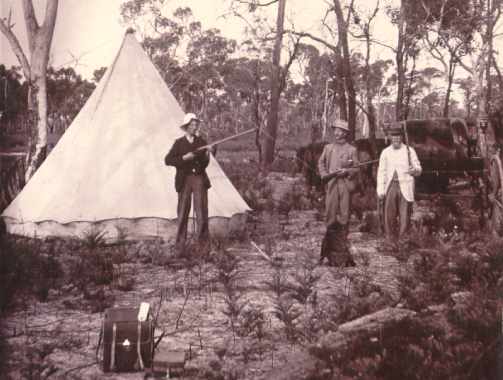
‘I also took two views of the camp - a stereoscopic and a whole-plate. The nearly eleven-foot yacca, with ordinary ones for contrast made the photos more interesting. I got myself into the views to make the groups complete, and I may be seen, gun on shoulder, watching the camera, and winding up the reel of thread which set the shutter in action and thus took the photos. (Photograph below) The actinic light was bad there, and long exposures were necessary.’
Below: Henry Tilbrook's photograph of the camp. His camera case can be seen in left foreground. Henry at right, Fred Lester next to him, Mr. Olsen in front of the tent.
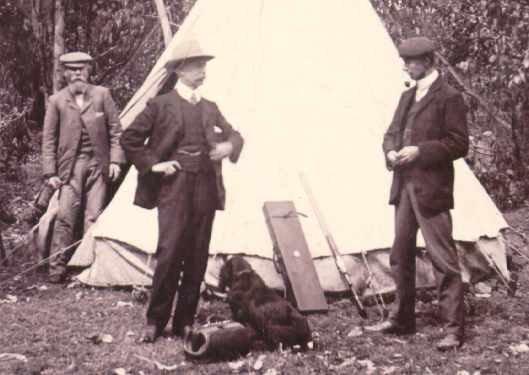
Below: Another enlarged section of a stereo view showing Henry, Fred Lester and Mr Olsen appearing a little over-dressed for a party camping out in the Australian bush, many miles from the nearest township. Henry, as usual, is standing rigidly, winding up the thread that triggers the camera shutter. His camera case is in the foreground.
They reached Portland and stayed there two days. ‘Lester kindly went with me while I was out taking photos to give me a helping hand. After taking many views of the harbour and the outside Heads, we went up the jetty, then came back and looked for an eating-house or a restaurant to obtain some lunch.’ They had an excellent meal and when the woman said it was only one shilling Henry was astounded. ‘That was the cheapest real feed I had ever had. I pressed two shillings into her hand and said I wanted no change.’
‘I took five photographic views on November 3. The changing of the plates at night necessitated heavy work on my knees. It usually took me two hours. The changing and packing of negatives was truly laborious under such circumstances, especially when they were of such large dimensions as whole plates, 8½ x 6½ inches, for a darkslide that size when opened was nineteen or twenty inches in length. The wind was so strong in Portland that it was almost impossible to take photographs that required a time exposure. I could not use my long-focus and telephoto lenses on that account as they all demanded a long exposure. I took a view of the harbour in two sections, and one of the coast outside the Heads, near the old fort, showing Laurence Rock out at sea.’
On their way home they came to a place called Brunberg. ‘There were two houses there, both uninhabited. This was about six miles past Heywood. The road was getting very bad indeed -- mud chiefly, cut up by the timber waggons, although we saw ne’er a one. Taking possesion of the best house, we resolved to camp in it that night. But save me from such houses! The tent was infinitely more preferable. Having taken the horses out and fed and watered them -- fresh running water was abundant -- my mates went into the scrub and forest for game, whilst I took my camera and obtained some photos of that lonely quiet spot, with its stately trees awaiting a bush fire or the lumberman's axe to lay them low.
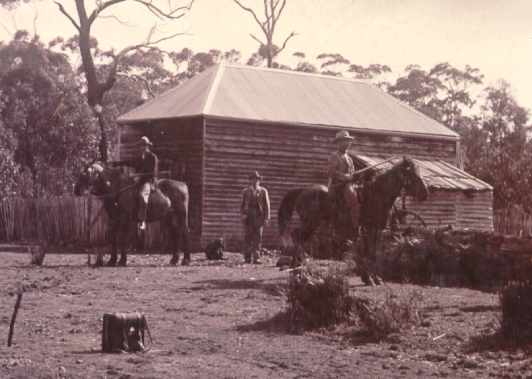
‘The house we took possesion of was of weatherboard. (Photograph below) It contained two rooms and a passage, and it had been papered. So some woman had been there! It had a broken down chimney of wood, with a dwarf wall of stone at the base to keep the fire away from the woodwork. The dawrf wall was gone, the stones lying in a dismantled heap in the fireplace. I swept the place out with a broom of brushwood. There were holes in the floor and walls -- mice holes or snake holes. Nearby was an old galvanised iron tank lying on its side with the words POISON IN THE TANK! painted on it. Needless to say we gave that tank a wide berth.
‘Outside the building trails clear and distinct indicated where animals or reptiles were in the habit of creeping beneath the floor. Some openings looked like snake holes. Others were worn smooth by the persistent passage of animals squeezing and scraping through.
‘My mates enjoyed themselves around the fire. But I had to change plates [removed exposed and replace with fresh] for the next day. I was two mortal hours in the other room doing this -- on my knees, with a mask on my face this time, for I had altered the contrivance for this trip. I changed eight exposed negatives - half-plates, whole plates, and 8½ x 3¼ plates - labelled and packed them in order in as many separate boxes, and filled the slides with a similar number of new sensitized plates. As they had all to be dusted, and also labelled to correspond with my notebook, and the faces away from touching each other, the job was no sinecure. All this had to be done by the light of single sperm candle shining dully through a dark ruby glass set in the side of the red tent, the candle being outside the turkey twill. The pictures ought to have turned out good ones, the trouble I took with them. And they did!
‘Those hardwood floors were hard! And I was cramped almost beyond endurance. Although I was alone in the room, I had the friendly attention of cockroaches that made their home there. They ran over me and up my trouser legs, to see if I was an animal worth eating. Other insects also seemed eager to make my acquaintance, and came running along the floor from everywhere. I had to stand it all -- or rather kneel it. For had I unbound my head and taken it away from the little red tent, the white light from the candle -- being actinic -- would have spoiled my sensitized dry plates. In two hours’ time my unpleasant duty was finished and the roaches and other reptiles scampered away when they found I was still alive.
‘That night the three of us slept on the specially hard floor. It was almost as hard as the adzed pine-slab floor that Lester and I slept on at Wilpena in 1894. Things were running about the floor that night, but what they were we did not try to find out. Daylight made everything right again, and we welcomed the dawn in the eat, and did not wait for old Sol to rise before we were up.
There was a hill to the east of us. It was fairly clear of big timber. Beyond it were some fine tall gums standing all bare, dead, naked and white. They made such a striking picture amidst the tick underbrush that I went there and took some photos of them. In one of the photos I myself stood at the base of a large dead tree to show its fine proportions in contrast to a man. I afterwards photographed the three of us with the hut in the background - two on horseback, I on foot winding up the thread attached by a devious course to the camera standing there alone. In this picture we look like a party of sharpshooters out fighting the Boers in South Africa. This is a stereoscopic view from which I made some enlargements.’
Below: The party in front of the house at Brunberg. Henry in the centre winding up his thread, his camera case placed prominently in the foreground.
‘November 7, 1903. On this day I was busy taking photographs whilst my friends were hunting for something to shoot. I roamed about alone all day in order to bring back photographic records of the scenes we had visited. One of my views was, of course, a presentment of our camp with the three of us in the group. As soon as I had focussed this picture I discovered immediately beneath the camera, between the legs of the stand, a large snake hole. Not being willing to shift the camera, as I had selected the position carefully, wishing to show a tall, dead, bleached tree on the right hand, I cut a stout stake and rammed it tightly down the hole. That night I changed eight plates. I took some interesting views at this camp among the lagoons, and one showing the standing tent across the water.’
The party moved on and by the time they reached Mumbannar Lagoon a storm was approaching so they looked foer a suitable camp site. ‘The camp we selected was three feet higher than the water but had no view. Protection from the weather, from a western storm, was what we sought, all of this by this time having a dread of what might happen to our military tent when rude Auster (the S.W. wind) started on his frolics. Burned and blackened, but not dead, forest trees were around us, and there was plenty of fallen dead wood. At this camp we put from half to one ton of wood on the fire at a time. It was stringybark, and big -- tree trunks and limbs in fact -- and the fire would not burn with a lesser quantity.
‘The storm came upon us soon after the tent was erected. On the floor bracken ferns were growing. These we cut down close to the ground, for the stems were hard and stiff. Then gathering soft branches of teatree we strewed the ground with them. Over this we spread the canvas hammocks, and were as comfortable as could be expected under the circumstances. We had a cosy camp that night. A great fire was roaring outside, the rain was pelting down, and the wind was shaking the foliage. But we were quite secure, being amply sheltered by the teatree. We found a few bulldog ants inside the tent, but they were too lethargic, owing to the cold weather, to sting us.’
‘November 9, 1905. Mr McKinnon, whose house was on the other side of the lagoon, and is to be seen in my pictures, paid us a visit. He had resided here for forty years. He used to keep a wayside inn, but it was accidentally burnt down, and a fifty pound note was consumed in the flames. Hard luck for him! But what custom there was to keep a wayside inn going I do not know. There was only one other house at Mumbannar, and that belonged to his brother. It was just a hut of two rooms.
‘I tool many views of this interesting place, although, as usual throughout the trip, the weather was very unfavourable. According to my journal we were about twenty miles to the east of Mount Gambier. Miss McKinnon sent us along a large and most delicious gooseberry pie, and she and her father were very kind to us during our stay. And yet I never clapped eyes on the lady! Whenever I visited the house she kept discreetly inside, and she did not once visit our camp. Mr McKinnon was the only human being we saw here. When I returned to Adelaide I wrote thanking them for their kindness, and forwarded a packet of photographs.’
‘One evening Mr McKinnon called at our tent and asked if we would like to see the Caves. Accordingly, next morning, early, our Scotch friend brought up his horse and trap. He also had a long stout rope aboard. This was to let ourselves down into the caves.’
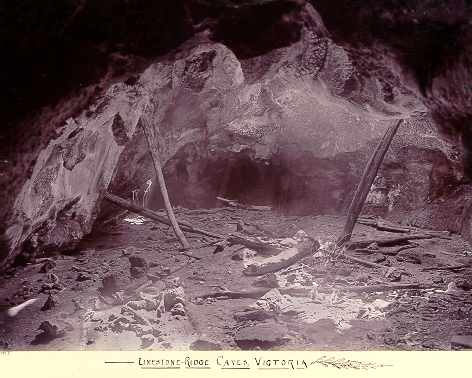
‘I had told my mates to get things ready whilst I packed my camera, plates and magnesium ribbon - for I had brought a supply with me for such contingencies. The Caves are three miles west of Mumbannar. They are named The Limestone Ridge Caves. The long rope was securely fastened to a stump and we let ourselves down thirty feet into the depths below, hand-over-hand fashion, with our feet against the sides. From there we wndered over those parts that were sufficiently well lighted from the openings overhead. There was one very large chamber, some thirty feet wide by seventy or eighty feet long, passages going from it in all directions, some being difficult of access. In places we had to stoop and crawl through. There were several other chambers of smaller size.
‘At one place was the skeleton of a bull. The live animal had, forty years previously, fallen down thirty feet from above. It was four years before the body was found. It was crouching as if asleep. The whitened skull shows in my photographs. My camera and stand had been let down one of the big holes with the aid of a rope. Whilst I was picking out spots to take photos from, Lester went into a darksome passage, exploring. But some distance in the roof had come down to the floor and, his matches giving out, or little bit of candle that he had, he became jammed, and was in a great fix, being in total darkness. He called out at the top of his voice, but I did not hear him. I was at the time focussing the big chamber with my lens. That being done, and the exposure started, I was going to follow him up. But fortunately Olsen heard him calling and went to his rescue.
‘After my mates had had a look around they, with my approval, left me down in the Caves while they went back to dinner. Climbing up the rope they disappeared with Mr McKinnon. I took photos down in the lower regions during the rest of the day, but as some of the exposures required forty minutes and others twenty minutes I did not take many. I augmented the dull gloomy light by igniting magnesium ribbon and got some interesting photographs, although I found most of them overexposed.
‘The Caves must be very ancient, for some of the pillars formed by the dripping of the waters were two feet thick. Swallows flew down the openings from above and built their clay nests on the walls. The nests contained three eggs each. What stalactites there were, were very massive. All the more delicate stalactites had been broken off by vandals. I took five photos altogether during the day, two being stereoscopic. One of the whole plates turned out a failure owing to smoke caused by the burning of the magnesium ribbon, the smoke having been blown back on me and the exposure a long one.’ Henry's friends returned with a Dietz lantern and together they explored the Caves. ‘Having satisfied our curiousity we climbed to the surface, drove back to the tent, and thus ended the day's adventures -- but not my work, for I had to change plates.’ The next morning Henry took four 8½ x 3¼ views, but it rained all afternoon which put an end to his photography.
Below: ‘Limestone Ridge Caves, Victoria.’ From a whole plate print in one of Henry Tilbrook's albums.
‘12 November 1905. Made a start from Mumbannar. We proceeded through swamps and timber. At one spot the track was on a decline and went straight through a lake half a mile across. At that spot we happened to meet Mr McKinnon, who had been to a kirk somewhere or other -- heavens knows where. He was on horseback and had just ridden through the lake. He gave us instructions where to steer for on the far distant shore. We plunged our horses into it. We did not know what was beneath us but notwithstanding that the water covered such a vast patch of land, it was not above the axles of out trap. After some hard pulling and splashing we got across in safety. I should have liked to have taken a photo of the trap in the water but there was no time.’
They pulled up near some lagoons and ‘erected the tent for show purposes, stretched a string of Jack snipe across the white canvas, and I took a photograph of the whole group, myself included. Also another photo of the trap, with Lester and I aboard and Olsen on the three year old colt alongside. It was a pretty scene with the surrounding trees and lakelets. These photos were taken under difficulties, for the weather was stormy and showers fell frequently. In each case the unfortunate camera had to stand away from us, solitary and alone, after the focussing, while I manipulated the reel of thread from the group. For there was no one to expose the plate. I had to hide the thread away at the side among the shrubbery, then up to the camera, so that it would not show in the pictures.’ Lester and Olsen went off hunting for Jack snipe and Henry took two more views on 8½ x 3¼ inch plates.
At 6 pm they packed up and left the swamps, following a twisting, forking track, sometimes having to turn back and try another branch of the trail, anxiously looking for the white ribbon of limestone that would tell them they had reached the safety of the Mount Gambier to Casterton road. ‘The light was so uncertain that the trail was hard to follow, and we couldn’t follow it on foot. At last it became dark. What was that faint streak of white ahead of us, shining through the timber? Could it be the road we were seeking? Yes! We had struck the Road at last!’
It was 10 pm when they reached Mount Gambier after an absence of fifteen days. ‘A small fire awaited us. When sufficiently warm I started changing plates, and this took me till twelve-thirty on Monday morning. Then I retired to a comfortable bed and slept soundly till daylight.’
‘November 13, 1905. On this day I travelled on foot with camera around the volcanic lakes of the Mount and took eight more views. These included a different one of the Valley Lake, a stereo of Gordon’s monument, and one of the Centennial Tower recently erected. I walked all around the Blue Lake taking photos as I went.
‘November 14, 1905. In the afternoon I took a group photo of my friends. They were Mr & Mrs Lester, Mrs Carter (widow of late Blakeney Carter, solicitor, of Clare) who was there on a visit, Dorothy Lester and Miss Effie Gibbs. The latter young lady was staying there as company for Dorothy, as they both went to the same private school. Her home was at a wealthy squatter’s mansion. Dorothy called Mr and Mrs Lester father and mother. But she was really an orphan, a daughter, I believe, of Mrs Lester’s deceased married sister, of Sydney, NSW, and Mrs Lester had adopted her.
Henry returned to Adelaide by train. ‘I arrived at the Adelaide Railway Station to find my dear Marianne there to receive me in her affectionate embrace. How happy we were to get together once more! She told me how she had longed for me to come back. I got back to her. But twelve months afterwards she did not come back to me, but left me for ever, desolate and alone.’ (Henry’s wife died on 15 December 1906 and in the same year his friend Fred Lester was promoted to the position of manager of the AMP branch at Launceston, Tasmania.)
‘My photographs all turned out well. And Marianne helped me fix and wash them all. Photograph prints - whether Printing-Out paper (P.O.P.) or Bromide - require a tremendous amount of washing to get all the hyposulphite of soda out of them - otherwise they would fade away or turn yellow. FINIS.’
END.