 Edwin
A. SCHOLZ
Edwin
A. SCHOLZ |
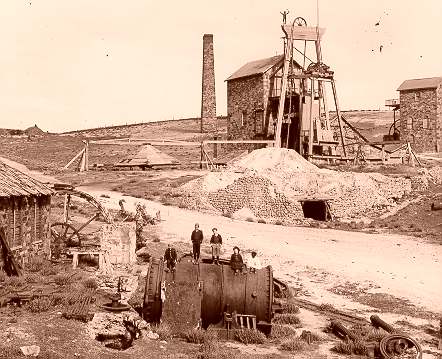
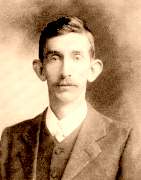
Born at Riverton in 1881, Edwin (Ted, or Eddie) Scholz was a wheelwright by trade and an amateur photographer by choice. He was a regular and successful exhibitor in the photographic section of local shows, usually entering scenic photographs in the ‘under half-plate’, ‘over half-plate’ and ‘postcard’ classes. Some of the shows where he is known to have won prizes were: Auburn, 1905 to 1908; Saddleworth, 1906 and 1907; Clare, 1919 and 1920. Edwin Scholz died in 1952, leaving behind a collection of glass negatives he had taken in different parts of South Australia c1900-1910. In 1906 Edwin Scholz photographed the old buildings at the Burra copper mine and his half-plate glass negatives have been preserved. The picture you see below shows some children standing on the massive cylinder that was once a part of the Cornish steam engine that was housed in Schneider's pumphouse. Other parts of the engine lie around it. Behind it and to right of centre is Morphett's pumphouse which, when the photo was taken, still housed an identical engine. This page is still under construction. More to be added. If you would like a closer view of the cylinder just click on it with your mouse and your browser will load an enlargement. Use your BACK button to return to this page. You can do the same with Morphett's pumphouse and, if you are familiar with the method of temporarily hiding the toolbar, location bar and any other bars at the top of your screen, you can obtain an even more impressive picture of the pumphouse. It is to the photographer's credit that when I made a 16 x 20-inch enlargement of the pumphouse I could count the wires in the fence on the crest of the hill. Morphett's pumphouse building has been restored and is now open to the public. |
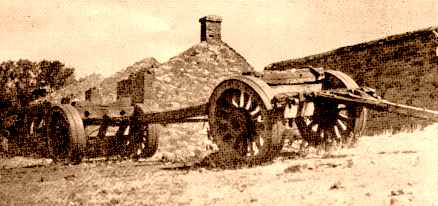
Transporting Schneider's pumping engine to the Burra mine was a great achievement for a colony that was less than twenty years old. The parts of the engine arrived at Port Adelaide on the ship Joseph Weir in April 1851, and it was loaded onto a great jinker that had been constructed in Adelaide for the sole purpose of carting the massive cylinder to the mine. The Cornish boilers were brought to the mine in sections and assembled on the spot.
An experienced bullock-driver, Bell Freeman, was given the task of transporting the cylinder, which had a bore of almost 7 feet and weighed 18 tons. Freeman started out in January 1852 with a team of 72 bullocks, six abreast at the face of the jinker, ten in the next rank, then a gradually decreasing number until he was down to his two leaders at the front. To make sure the few bridges on the road were not damaged Freeman had them shored up with timber and the decks covered with a layer of sand to dampen any vibration. As an added precaution he drew the jinker as close to the bridge as possible, had the bullocks unhitched and taken over the bridge, the team re-assembled on the other side, then the jinker hauled across with long ropes. Some years later the same jinker was used to carry the cylinder of Morphett's steam pump to the mine. Today this jinker is a sad and sorry-looking relic, housed under an open shelter in one of the streets of Burra, an ignoble ending for such a fine piece of pioneer South Australian craftsmanship, a piece of Australia's transportation history which played a vital role in Burra's past. No jinker, no pump, no mine! |