‘Professor’ Robert HALL
Robert Hall had arrived in South Australia by 25 August 1842, the day on which he married Ruth Smith in Trinity Church on North terrace, Adelaide. Ruth was the eldest daughter of Richard Smith, a Hindley Street butcher.
From 1842 to 1846 Robert Hall is listed in directories as an was an ornithologist, Currie Street, Adelaide, and in October 1842 J.B. Neales offered for sale by auction a portion of his collection of birds which were mounted in glass cases. In March 1845 he appeared in court on a charge of stealing ‘a variety of stuffed skins of birds,’ but was acquitted by the jury.
Robert Hall returned from a professional trip to Melbourne in October 1845, and brought with him some specimens of natural history including several platypus, and a live echidna which had been caught near Mount Schank. The echidna was fed on bread, milk and white ants and although Hall felt it would survive the change of diet and a trip to England, where a live specimen was worth £100, it only remained alive a few weeks. The platypus were stuffed and one was sent to England.
Hall had travelled to Melbourne on the Spartan but chose a small eight-ton craft for his trip home. The Register reported: ‘Mr Hall, whose travels on terra firma are generally out of the beaten track, has been equally eccentric in the choice of his sea conveyance from Melbourne, having arrived here in the [8-ton] Ettrick, a "jewel of a craft." But our adventurous fellow-colonist was not mistaken in his estimation of the capabilities of the Ettrick, having made a short as well as safe passage [of] only eight days from Melbourne to Port Adelaide, including 30 hours detention at Portland.’
In January 1846 Robert Hall acted as an agent for a newly-arrived German daguerreotypist, Edward Schohl (q.v.), who was taking portraits at Robert Sanders’ drapery shop in Hindley Street. Three months later Hall was making his own daguerreotypes at the rear of his residence at the west end of Currie Street, having purchased the daguerreotype apparatus ‘lately arrived from Paris.’ He could have received instruction in the art from Schohl, and his daguerreotype apparatus was almost certainly the one which had belonged to S.T. Gill, who left Penwortham in July 1846 as artist to the Horrocks expedition which was to explore the northern part of South Australia.
Although the Register reported, on 22 April 1846, ‘a new triumph of colonial genius in the perfect acquisition by Mr Robert Hall, of the Daguerreotype apparatus … which he operates in the most successful manner’, a somewhat less perfect picture was recorded in the diary of Miss Mary Thomas. ‘17 April 1846 – A Mr Robert Hall has been making experiments with a daguerreotype apparatus lately, so Frances and I called upon him with the intention of sitting to him by way of a trial. He took our likenesses three times. My sister and I sat together, and on two occasions little Fanny Skipper was grouped with us.
‘23 April 1846 – Frances and I sat again to Mr Hall this morning and he took our portraits in daguerreotype. He did not succeed very well, so that the plates will most likely be rubbed clean again as the others were.’
The cost of Robert Hall’s daguerreotypes was one guinea each, including a ‘handsome frame’, his hours of attendance were from 10 am to 4 pm, and he asked sitters to avoid wearing white. By 25 May 1846 Hall had moved his daguerreotype to premises adjoining Mr Pybus’s in Hindley Street.
Robert Hall paid a brief visit to Western Australia in November 1846 and made the earliest recorded photographs in that colony. He arrived there on the 9th, on the 141-ton clipper-schooner Joseph Albino, and set up his daguerreotype apparatus ‘for eight days only’ at the rear of Mrs Leeder’s hotel in Perth, his prices and hours of business being the same as they had been in Adelaide. On 25 November he left for South Australia on the same ship, his visit having been longer that the ‘eight days only’ that he had advertised.
For the next few years Robert Hall appears to have worked as a daguerreotypist at irregular intervals, probably influenced by a fluctuating demand and the presence of visiting daguerreotypists. In January 1847 he advertised that he would re-open his daguerreotype on the 22nd ‘for four weeks only’ in the premises next to Mr Joshua’s store in Hindley Street that had previously been occupied by Mr Mackie the bootmaker. His price for a portrait had been reduced to 15s. in a morocco case or 12s 6d in an open frame.
In February 1847 an exhibition of the work of resident colonial artists was arranged to coincide with the Agricultural and Horticultural Show. Robert Hall exhibited four daguerreotypes at the exhibition: one titled ‘Lord Brougham’; two, each titled ‘S.A. Native’; and one called ‘Four Aborigines’. He also arranged a lecture on astronomy complete with orrery, and a series of dissolving views to take place in the new Queen’s Theatre on the evening preceding the day of the show. Mr Cooper Searle delivered the lecture on astronomy, supported by ‘transparent diagrams’, but the non-appearance of the orrery as promised by Robert Hall caused general dissatisfaction. A number of dissolving views were shown, which were ‘very good’, and Mr Nieman’s performance on the accordion was ‘creditable’. When Hall appeared in court for not paying his account for advertising in the Register and Observer he was facetiously referred to as ‘the celebrated Ornithologist, Daguerreotypist, Professor of Phantasmagoria, and lineal descendant of the Earl of Orrery.’ Robert Hall may have been one of the partners of Hall and Plush (q.v.) who exhibited dissolving views in ‘Mr Joshua’s large room’ in April 1847.
Another exhibition of paintings took place on 10 February 1848, again coinciding with the Agricultural Show, and again Robert Hall exhibited daguerreotypes, all of which were outdoor views: Government House, Trinity Church, the Bank of South Australia and the Exchange.
By February 1848 Hall had moved to Morphett Street, four doors south of Hindley Street, where he was open for business ‘daily, from 10 o’clock till dusk’, and that having received a fresh supply of chemicals and plates he was prepared to take portraits at a reduced price, half a guinea (10s 6d), including a morocco case. A few months later his daguerreotype apparatus ‘including upwards of 200 plates, chemicals and instruction book’ were advertised for sale, and he announced that he would continue taking portraits until the 30th March unless his equipment was sold before that date. His apparatus may not have been sold as he also had a daguerreotype for sale the following year, in June 1849.
Robert Hall must have decided there was more money in accommodation than in portraits. In July 1848 ‘Hall’s Boarding Establishment’ opened at the west end of Hindley Street, which was claimed to be ‘the most healthy part of the city’, with ‘an extensive view of the sea and country in every direction’, and within ‘five minutes walk’ of the banks and public buildings. Hall offered to re-commission the former Signal Station which was on top of his residence if 15 could be raised to provide the necessary flags and a good telescope. When the building had been occupied as the offices of the Register the signal station had signalled the arrival of ships in the gulf.
This building may have been the one Octavius Skipper referred to in his reminiscences. ‘In the winter of 1846 we moved out to a section at Islington belonging to R.G. Thomas, who was then in England, and in consequence of the great success attending the discovery of the Burra Copper Mines, business began to hum in Adelaide, and Mrs R. Thomas, sen., let the house we lived in to a Mr Prettyjohn, who obtained a publican's licence in respect of it, and afterwards sold his interest to Bob Hall, known at that time as Pegleg Hall from his having a wooden leg, and Hall in turn being a speculative man parted with his interest to a Captain Maitland for £800, reckoned a goodly sum in those days.’
Robert Hall’s establishment was renovated and on 21 December 1848 opened as the Clarendon Hotel, but six months later he was making arrangements for a trip to England and under the heading ‘A Fortune for Anyone with a Small Capital’ advertised a complete daguerreotype apparatus for sale.
On 26 June 1849 the South Australian reported that Robert Hall was to take a group of aborigines with him on his trip to England. ‘We hear that Mr Hall (the Naturalist), intends taking Denbry, the Murray chieftain, and several other natives, to England, where they will no doubt become objects of passing curiosity. We believe it was Denbry’s son who was presented to the Queen by Mr Eyre. The old fellow is a fine specimen of the former lords of South Australia, and is said to be the only real chief among the natives. His authority seems to have been derived entirely from his personal prowess, and is acknowledged by submission to his judgement and the rendering of triibute. What may become of these illustrious strangers in England after the exhibition, it is difficult to say. The British government sometimes requires persons landing savages to give security for their due return to their native land, but we opine it could not do so in this instance, inasmuch as the ‘gentlemen in black’ are by law no aliens but British subjects.’
At the meeting of the Licensing Bench held on 10 December 1850 Robert Hall was granted a licence for the Phoenix Hotel at the corner of Hindley Street and Clarendon Street. A report of the meeting said that Hall had ‘paid a visit to England to procure furniture for the erection of a large house [hotel].’ In August 1851 he advertised that he had ‘at considerable expense ornamented and beautified his capacious Saloon with the matchless pencil of the great Australian artist, Mr Opie,’ and that he would be holding a series of balls at the hotel.
By the end of January 1853 Robert Hall was back in the daguerreotype business, but for ‘one month only.’ His ‘Patent Colored Daguerreotype or Photographic Portrait Establishment’ was located in Hindley Street, five doors west of the Phoenix Hotel. In August 1854 he returned from another trip to England and advertised that he intended ‘shortly opening a Photographic Establishment, for the purpose of taking Portraits, &c., either by the Daguerreotype, Calotype, Talbotype, Albumen, or Collodion process, [and] pictures taken for the stereoscope.’ He also had on sale views of Venice, Paris, Syria, Rome and England, stereoscopes and stereoscopic pictures, which could be inspected at his temporary residence in Currie Street, opposite the John Bull Mail Office. A few months after his studio was opened Robert Hall assumed the title of ‘Professor’, which he used in an advertisement in the Register on 11 October 1854, and later advertisements were all made under the name Professor Hall.
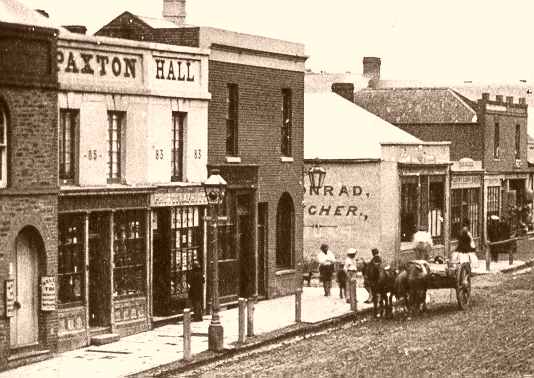
In December 1854 Professor Hall moved to ‘extensive premises’ on North Terrace, next to Wyatt’s foundry, and eleven months later he made his last move as a photographer to 83 Hindley Street, ‘lately occupied by Mr Muirhead and adjoining Dale’s Medical Hall’, where he remained for the next ten years. He was elected councillor for the Gawler Ward in May 1856, 45 votes to 2, but was replaced by another by the end of the year. He was again elected to Council in April 1862 to fill a vacancy created when Mr English became Mayor of the city.
Below: Professor Hall's photographic studio at 83 Hindley Street.
On 6 July 1858 Professor Hall and his family returned from a trip to Melbourne on the 337-ton Havilah, bringing with him a photograph he had taken of the ‘monster’ Welcome Nugget, and in August he made a ‘well-executed and correct likeness on a large scale’ of the explorer ‘Mr Gregory’ and sent a proof copy to the Illustrated London News.
The Professor’s difference with rival photographer Townsend Duryea over crayon photography (q.v.) was publicly aired in the columns of the newspapers in August 1859, and later that month he received by the Antipodes a camera with Ross lenses which could take photographs 24 x 22 inches. ‘Mr Hall informs us that as soon as all the accompanying apparatus arrives, he will be able to produce portrait busts nearly life size, and landscapes of proportionate dimensions. In addition to this apparatus Mr Hall has shown us some microscopic photographs on glass which, when observed with the naked eye were almost imperceptible, but when viewed through a powerful microscope exhibited a perfect, distinct and beautiful picture.’ In August 1861 he imported some Stanhopes (q.v.), micro-photographs attached to a minute magnifying lens which were concealed in pieces of jewellery.
In August 1860 Professor Hall received from England some stereoscopic slides of a new style which were known as ‘illuminated photography’ (see Stereoscopic Photography) and in April 1862 he was making his own stereoscopic photographs of local scenery. ‘They represent many picturesque and well-known views; such as bridges in various parts of the country, the Reservoir, Glenelg Jetty, the Gorge seen from Mount Lofty beyond Fordham’s, Oaklands, the Sturt, views on the Onkaparinga, the Waterfall Gully, &c. We have no doubt many copies will be sent home to friends in England, as they give a very pleasing and, of course, correct representation of several pretty and characteristic pieces of colonial scenery.’
Professor Hall appears to have been the first to show carte de visite photographs in South Australia, in February 1861. ‘A considerable number of persons was on Saturday assembled outside the establishment of Professor Hall, in Hindley Street, the object of attraction being a case in which was displayed specimens of a new description of visiting cards which have been recently introduced among the aristocracy of England. The cards are none other than small paper photographs which are taken in such sizes as to enable them to be slipped into morocco cases having embossed frames, or into albums similarly provided, which are intended for the hall or drawing- room tables. A visitor calling, instead of presenting the old-fashioned card, slips his photograph into one of the embossed pages of the album or case. These pictures are mounted on cardboard, and the name can be written underneath when necessary. The pictures exhibited by Mr Hall, are by Mayall of London, and are principally members of the royal family. Among the collection is a very excellent likeness of General Garibaldi.’
Photographs of local aborigines always attracted interest and Professor Hall’s portraits of the four aborigines who were to be executed for the murder of Mrs Rainberd and her children, taken in May 1861 with the Sheriff’s permission, were described in the press. ‘The portraits, which have evidently been taken under the most advantageous circumstances as regards light, are extremely clear, every feature being truly defined. They are interesting as exhibiting varieties in native physiognomy, and those who have not themselves beheld the repulsive countenances of those fiendish murderers, and are at all interested, would do well to pay the Professor a visit. The portraits are half-length, and the blacks are stripped to the waist, exhibiting a corpulency and powerful development of the muscles sufficient to set completely at defiance all the descriptions of Australian natives which we have ever read. Professor Hall has also taken the four men in a group, dressed in their prison clothes, which certainly imparts to them a more civilised appearance, but withal represents four heads which could never be taken to belong to other than individuals of the most savage type of humanity.’
In 1864 the Professor sent to the office of the Register ‘two interesting memorials of the once numerous and warlike Murray blacks. As portraits they are fine specimens of the perfection which photography has attained, and they are doubly interesting as pictures of a race that is fast "passing away". The portraits are in the style of ordinary cartes de visite, giving the ethnologist and physiognomist a clear idea of the aborigines "head and front", without so far adhering to nature as to dispense with decent attire.’
In 1861 the Professor experienced an unusual run of good luck. When he won a hack with saddle and bridle at the Blenheim hotel it was the fifth horse he had won in a period of six weeks. He was less fortunate a few years later. He was returning from a pigeon-shooting match at Semaphore when his horse-drawn trap capsized as he was negotiating a part of the road which had been undermined by the tide. The shock of the accident forced his wooden leg hard up against the stump of his thigh, causing serious injury, and he was in great pain for some considerable time.
Many years later a pioneer recalled a story about the Professor’s wooden leg. ‘Bob Hall was the first photographer in South Australia – a most facetious individual… A customer went into his shop once. Hall remarked, as if in pain, ‘Oh, my leg is very stiff.’ ‘What is the matter?’ enquired the anxious customer. After more contortions from Hall, more pity from customer, Hall exposed the offending member to the pitying customer – it was a wooden leg!’
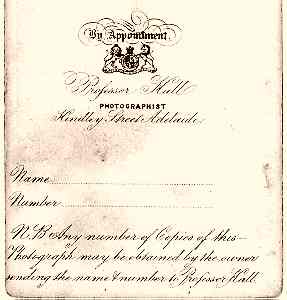 |
Left: The letterpress imprint on the back of Professor Hall's carte de visite. To reduce file size the plain top section of the card has been omitted. |
In January 1863 Professor Hall befriended a young Danish artist, Niels Peter Schourup
(q.v.), who had recently arrived in the colony, and employed him for a time as an artist
to colour his photographs. Later in the year Schourup opened his own photographic studio
at Port Adelaide, and it is likely he learnt the art of photography while working at the
Professor’s studio.
In 1863 he photographed the intrepid explorer, John McDouall Stuart, who was the first man to cross Australia from south to north. When The Journals of John McDouall Stuart was published in London in 1864, a carte de visite portrait of the explorer printed from Professor Hall’s negative was pasted in each book as a frontispiece. Printed around the lower edge of each oval-shaped albumen photograph were the words, ‘Professor Hall, Photo. Adelaide, Apr: 1863.’
Professor Hall retired from photography in December 1865 to become landlord of the Gresham Hotel at the corner of King William Street and North Terrace. A report in the Advertiser said that ‘a large number of persons, including influential citizens’ were present at a supper held at the hotel to ‘celebrate the advent as Host, of the well-known and popular professor of photography, Robert Hall.,’ and that the hotel was ‘henceforth to be known as The Corner.’
A month later Boord Brothers drew the attention of ‘Photographers, Chemists, Amateurs, and Picture-frame makers’ to an auction sale of Professor Hall’s photographic equipment that was to be held at his former residence at 83 Hindley Street on 23 January. Included in the sale were cameras, stands, patent plate-glass, various sizes of cases and frames, passe-partouts, chemicals, albumenised paper, mounts, cardboard, mats, preservers, dishes and pans.’ About a week later Boord Brothers advertised another auction on the premises for 31 January, the material for sale apparently being unsold items from the first auction and ‘six splendid painted scenes for backgrounds, also Works of Art and curiosities.’ Edward Farndell moved into the studio at 83 Hindley Street on 25 March 1866, and is possible he also acquired Professor Hall’s stock of negatives.
After a short illness Professor Hall died at the Gresham Hotel on 18 August 1866, aged 45 years, and was buried in the West Terrace cemetery. The Southern Argus published the following tribute to the Professor: ‘It was our painful duty last week to record the untimely death, in the prime of a vigorous manhood, of Mr Robert Hall, whose soubriquet of "the Professor" will be long and widely remembered in connection with many a merry hour and benevolent action. Mr Hall was an old colonist. For many years he conducted the business of a photographic artist in Hindley Street, Adelaide, and little more than six months since he became landlord of the Gresham Hotel, which he rechristened ‘The Corner’. Less than his memory deserves has been written of him by the contemporary press. Although he cherished some few eccentricities, which may have placed him beyond the pale of fashion, he had nevertheless peculiar virtues which will endear his memory to those who knew him best, and ought to ensure respect from all. His social humor and good-fellowship were far exceeded by his unostentatious benevolence and genial sympathy with the afflicted or distressed… few of us exhibit in our daily lives the same practical endorsement of the sentiment that always distinguished Robert Hall. It was his delight to assist and comfort those who were too much out of luck to profit by ordinary charity, and many an unfortunate, discarded by the world, will mourn the loss of a sympathising friend in the death of Mr Hall. The writer of these lines has had frequent opportunities of witnessing the truth of what they express, and they are offered as the merest justice to the memory of an honest and kindly hearted, if somewhat erratic citizen.’
One of Professor Hall’s children, Richard John Alexander Hall (q.v.), followed his father by becoming both a photographer and publican.
End.