 |
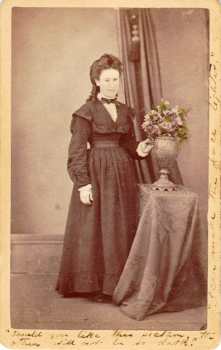
James H.E. BROWN. Left:
Carte de visite portrait by Jas. H.E. Brown. He has added a little colour to the flowers,
and written around the edge of the mount, "Should you like this picture, then others
will not be so dark. I can make the face lighter."
On the back of the carte he advertised himself as a landscape & portrait
photographer, and photographic colorist in oil and water color. "Life size portrait
from this card, £2 and upwards."
(Text continues below) |
An exhibition of dissolving views was shown in the Adelaide Town Hall
by James Brown during March 1873. The views showed Gustav Dore’s well-known
illustrations of the Life of Christ,and the glass transparencies, which had been coloured
by Melbourne artist James Moore, were projected on the screen by a powerful oxy-hydrogen
limelight. The views had been brought from Melbourne after being shown at the
Inter-Colonial Exhibition earlier that year. The dissolving views were later shown to the
inmates of the Adelaide Hospital for the Insane, where the disc of light projected on a
curtain was 12 feet in diameter.
In February 1874 James Brown arrived in Clare where he advertised in
the Northern Argus that he was a ‘landscape and portrait photographer and
colourist from Victoria’ and was prepared to photograph ‘gentlemen’s
houses, invalids and family groups.’ A few weeks later Brown produced his
‘Leporello’ album, sold for 8s., which contained views of Clare: the Town Hall,
Police and Telegraph Stations, public school with teachers and pupils, the Institute,
churches, Wesleyan parsonage, and John Hope’s residence, ‘Wolta Wolta’.
In his advertisement in the Northern Argus on 26 June 1874 Brown
published a list of testimonials which he had received while in Melbourne, including:
Johnstone, O’Shannessy & Co., portrait photographers; J. Tanner Esq., Jas. Moore,
and Miss Noble, leading portrait painters; Davies & Co, photographers; and W.I. &
F.C. Burman, landscape photographers.
In December 1874 the ‘Clare astronomers’ turned out to
witness the transit of Venus. Brown took several photographs at different phases of the
transit using exposures around one-quarter of a second, and the results were described as
‘very distinct’.
On 8 January 1875 the Northern Argus reported damage done by
vandals on New Year’s Eve: ‘Mr Brown, photographer, had his tent torn open, and
nearly everything destroyed, so that he is a loser of about £15. This was done opposite
the police station, where the tent was erected... it is clear that those who were bent on
making havoc were too smart for the police [who had been on duty until 3 a.m.], for they
actually proceeded to the stables of the police, took their buggy from a shed, dragged it
into the quarry adjoining, and backed it over the rocks into the pool adjoining, so that
only a portion of the pole was visible.’ By March 1875 James Brown had left Clare and
his business had been taken by Walter Rowe.
End.