
South Australian Panoramas
The panoramic camera as we know it today was unknown in the 19th century. Panoramic photographs were made by mounting the camera on a tripod and then taking a series of overlapping glass plate negatives until the required field of view had been covered. The resulting prints were then trimmed and pieced together, and due to variations between negatives and the printing out of the positives, the joins in the finished panorama are easily seen.
Although a five-part panorama of Hobart made in 1855, and panoramas of other settlements made in the eastern colonies in the late 1850s, South Australian photographers did not enter this field until the mid-1860s. In 1860 the Register reported that Mr Reylin, the Rundle Street photographer, had taken a set of four views of the new reservoir ‘which form a complete panorama,’ but on reading a report on the same set of pictures published by the Advertiser we find that the views were taken from four different positions and looking in four different directions.
In 1863 George Burnell took a series of eleven stereo photographs of Adelaide from the tower on top of the Register building. The Register said, ‘No. 1 takes in the buildings lying northward of the point of observation. No. 2 takes in a portion of King William Street, commencing from the Exchange northward. In No. 3 the Bank of Australasia stands out bold and conspicuous. These views are continued round until the point at which they commenced is reached.’ It is not known whether any attempt was made to join the small stereo halves to make a complete panorama of the city. The set of eleven views was on sale for 30 shillings.
In September 1865, Bernard Goode took his camera to the highest possible point on the tower of the new Adelaide Town Hall, which was under construction. He took at least seven views of the city from this elevated position, but it is not known if his negatives overlapped so that a panoramic section could be made, or if he just photographed at random. The views he took covered the following areas:
| 1. | Flinders Street, including Baptist Chapel and Presbyterian Church, and part of Freeman St., and further on St Paul’s and Pulteney St. schoolrooms and Mt Lofty Range. |
| 2. | Franklin Street, including Methodist New Connexion Church. |
| 3. | Part of Grenfell Street, Gawler Place, North Terrace and Parklands. |
| 4. | South-eastern portion of city including Unitarian Church, St. Andrews Church, and Roman Catholic Cathedral. |
| 5. | King William Street and City Bridge road, Bank of Australasia. |
| 6. | Congregational Church, Hindmarsh Square, Hospital, part of Norwood and hills in distance. |
| 7. | Part of Waymouth Street and north-eastern angle of city. |
South Australia’s first real panorama was also its best, ever. A few months after Bernard Goode photographed Adelaide from the highest point of the Town Hall tower, Townsend Duryea also went to the top of the tower with his camera and created a masterpiece. By this time the stonework would have been higher and it is possible Duryea had a platform where he could mount his camera so that he had a clear view of the city in all directions. On 16 December 1865 the Register reported, ‘We had an opportunity of seeing what may be called a fresh triumph of photography. Mr Duryea has taken a series of fourteen views of Adelaide from the top of the Albert Tower, and the whole are arranged so as to form a panorama of the city 13 feet long. Indeed the views embrace the sea line on the west and the beautiful Mount Lofty range of hills on the east. Almost every house in the city is seen distinctly, and the public buildings stand out most prominently and sharply. The thing is very ingeniously done, and reflects great credit on the artist. It is a pity that the Town Hall, with its magnificent tower, could not be given to complete the picture. We understand Mr Duryea has already received several orders for copies, and we would advise our readers who want to see the city at one glance to visit that gentleman’s studio and judge for themselves of the merit of this his latest performance.’ Duryea offered his pictures for sale as either individual photographs or as a complete panorama mounted on canvas.
Taking the fourteen photographs that were needed for the panorama would not have been easy. Duryea was using the wet-plate process which meant that he had to have some sort of portable darkroom erected on the scaffolding around the tower, as his glass plates had to be coated, sensitised and developed on the spot. If the negative was allowed to dry at any point between sensitisation and development it was ruined, and as it was the beginning of December he would have had to work quickly.
The direction of the shadows cast in Duryea’s photographs show that he began in the morning with his camera facing north along King William Street, then rotated his camera in an anti-clockwise direction until in the afternoon his camera was again pointing north so that his last view slightly overlapped his first. By moving his camera in this manner he was able to keep the sun behind him and photograph, as much as possible, the sunlit face of the buildings. Had his camera faced the sun at any point he could have avoided flare on his lens with a shade, but would have been photographing shadows.
As Duryea’s fourteen separate views made a panorama 13 feet long he could have been using 10 x 12 inch glass plates for his negatives, and it is interesting to note that shortly before his panorama was open for inspection at his studio he advertised for sale ‘a superior lens, by Ross, suited for portraits or landscapes, 10 x 12 inches.’
Duryea’s panorama was copied and printed as large transparencies
which were mounted between perspex and arranged in a near circular backlit display to form
an ingenious, eyecatching re-creation of Adelaide as it was seen by Duryea in 1865. It was
first located at the Morlock Library in 1986, then moved to Old Parliament House in 1991,
and was finally given a home in Gay’s Arcade in 1998. Where next? An electronic copy
of Townsend Duryea’s 1865 panorama can be seen at the following Internet address --
http://fusion.com.au/duryea
In August 1866 Duryea advertised his view albums which, he said, ‘form a beautiful acquisition either for the drawing-room table or transmission home (to England).’ The frontispiece was a panoramic view of Adelaide and suburbs that was 3 feet long. In November 1870 Duryea advertised his ‘new series of photographic views of Adelaide from the Post Office Tower, comprising, in a handsome 12 x 10 volume, a complete panorama of the whole city and surrounding suburbs. He did not say whether the views were available only as a set of individuasl pictures, or as a continous panorama of mounted prints.’ In February 1873, in the general list of exhibits for the London International Exhibition, 1873, under Photographs, is the entry "T. Duryea - Panoramic View of Adelaide."
Towards the end of 1875 the Melbourne Photographic Company made a large panorama of Adelaide to the order of the South Australian Commissioner for the Philadelphia Exhibition. The Register reported, ‘The view commences with the Post Office, showing the Town Hall, Eagle Chambers, White’s Rooms, the National Bank, the Franklin Street New Connexion Church, The West Terrace Flagstaff, and all the minor buildings coming within the range of the camera. This photograph is about 12 feet long by two feet in width, and gives, when taken with the companion picture, six feet in length, a correct idea of the extent of the city. The second view is from Montefiore Hill, and takes in the South Australian Cricketing Oval, St. Peter’s Cathedral, and the Gaol.’ The Register did not say from which building the panoramic photographs were taken, just that it was from ‘the lookout of one of the highest buildings in King William Street.’
The Government purchased another set of the Melbourne Photographic Company’s panoramas for the office of the Agent-General in London. They were framed in maple with gold beading, packed in strong zinc-lined cases and sent to London on the Hesperus. A third set of panoramas remained in Adelaide in the office of the Commissioners of the Philadelphia Exhibition, and a fourth set was retained by the Melbourne Photographic Company for display in their Rundle Street studio.
Many smaller panoramas were made by enterprising city and country photographers. Around 1879 Richard Hall made a panoramic photograph of Port Lincoln, four whole-plate prints assembled to make a 30 x 5 inch view of the township and its harbour, a steamship at the jetty and Boston Island in the distance. It shows a game of cricket being played on the open ground in front of the Northern Hotel. The right-hand half of the panorama is shown below and, if you wish, you can see an enlargement of this section (140 Kbytes). It is about three times the full width of your screen.
If you do choose to see the enlarged picture on your screen, you can
return here by using the BACK arrow of your browser. Remember
to use your bottom scroll bar and arrows to move left and right to see the parts of the
picture that are off the screen.
To view the enlargement, CLICK HERE.
In 1881 the Areas Photographic Company took a series of photographs of Port Pirie from ‘the flagstaff balcony and Sucker’s lookout.’ The local paper said that the views were ‘a faithful delineation of the place and its facilities. They would be still more valuable if the manager could mount them in proper order, forming one large picture. For presentation to friends they are just what has been long wanted, and they should have a large sale, for nothing approaching them has before been offered to the public.’
The following year James Taylor advertised his ‘views of Port Augusta, showing the whole extent of the town and surrounding country, whole view 74 x 14 inches, mounted, £1 2s. 6d.; half view, 42 x 14 inches, mounted 12s. 6d.; any part unmounted, each 1s. 6d.’
In the early 1880s Edwin Marchant made a panorama of Clare from a series of five cabinet photographs he had taken from a hill on the east side of the town. A novel feature of the panorama was the way the pictures were joined together by cloth hinges so that the whole panorama could be reduced to the size of one cabinet photograph.
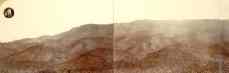
| Below: Henry Tilbrook made a four-piece panorama (27 x 4½ inches) of Elder Range from the glass plates he exposed there on 4 September 1894. He printed in (not pasted) his portrait in the left-hand frame. To reproduce the panorama two scans were made totalling 50 kilobytes and these were then placed side by side. If you wish to see the resulting panoramic image click on the image below (left half of panorama) and wait for it to load in a full width window. You can then use the bottom scroll bar to move across the panorama Henry Tilbrook made over 100 years ago. |
 |
End.