SOUTH AUSTRALIAN MOSAICS.
Portrait mosaics were popular in South Australia during the 19th century, and the
usual practice was to follow a theme so that all of the people in the portraits had a
common interest or occupation. That is, in the one mosaic they were all politicians, or
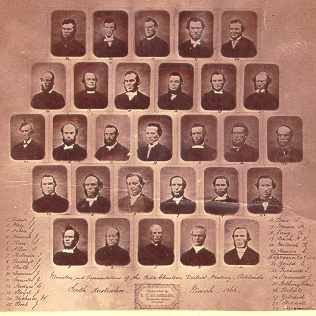
sportsmen, or perhaps ministers of the same religion, as in the case of Philip Marchant’s mosaic below.
 |
Left:
"Ministers and Representatives of the Bible Christian District Meeting,
Adelaide, March 1866." Albumen print copy (2 x 2 inches on a
carte de visite card) of a mosaic assembled by P.J. Marchant, Waymouth St., Adelaide.
All 29 portraits are numbered and named, the names clearly visible under a magnifying
glass. |
In 1868 Townsend Duryea made a mosaic in which portraits of all of the members of the
Legislative Council were grouped around a portrait of the President, and a list of names
was also included. The following year the Adelaide Photographic Company exhibited a mosaic
of 33 full-plate portraits of the officers in Goyder’s Northern
Territory Expedition, the central figure being Goyder himself, and it was reported that
they were ‘mounted on canvas skilfully illuminated so as to show off the pictures to
best advantage. The frame enclosing the whole is five feet by about six in width.’
In 1870 the Australian Photographic Company had on show ‘a
lithographic frame, enclosing the vignette, 70 in all, of most of the memers of the North
Adelaide Young Men’s Society. The central figure is the President, The
Rev. J. Jefferis. A pretty filigree border, executed by one of the members,
enhances the effect. The artist, Mr H.J. Thwaites, has prepared the work for
presentation to the Society, of which he is a member, to hang up in the classroom, to
which it will no doubt be a pleasing addition.’
However, it was the Old Colonists’ Banquet in December 1871 that
gave Adelaide’s photographers an opportunity to make mosaics on a large scale. The
banquet was arranged by Emmanuel Solomon, one of Adelaide’s leading merchants, and
over 500 of South Australia’s early settlers attended. In January 1872, Townsend
Duryea advertised, ‘Any Old Colonist who has not already received a written
invitation to sit for his portrait will please accept this notice to do so at once, as
Mr Duryea is desirous that every Colonist whose arrival dates prior to
January 1, 1841, should appear in his large group picture of the Pioneers of South
Australia.’ However, it is likely that Duryea already had most of the portraits he
needed somewhere in his collection of 47,000+ negatives.
A few months later Henry Jones, one of Duryea’s former employees,
was also inviting Old Colonists to sit for their portrait so that he, too , could
make a mosaic similar to Duryea’s. But so far only the gentlemen old colonists had
been invited to sit, and it is here that Henry Jones scored a point over his former
employer -- he invited the Lady Old Colonists to come in and sit for their own group
mosaic.
Duryea had not one, but several, group pictures ready in October 1872.
‘There are in all seven groups containing likenesses of men who arrived in 1836, also
those who came in 1837, 1838, 1839, and 1840, the other two sets containing respectively
600 and 800 portraits, the former of actual pioneers of South Australia, and the latter of
pioneers and those of their children who may fitly be called old colonists, but who
arrived at too early an age to be dignified by the title given to the others. The 1836
group is surmounted by a representation of the now historic gum tree. It is an interesting
study for early arrivals to look through the collection and see the faces of those with
whom they were associated or acquainted in the early days.’
Duryea advertised the size of his group pictures -- 1836 and 1837 were
21 x 28 inches; 1838 was 25 x 31 inches; 1839 was
2ft 10 ins. x 3ft 10 ins.; 1840, 3 ft. x 2 ft. Any of
these was also available as a carte de visite, 8 x 10, or
14 x 19 inch copy. There was also a complete group 3ft. 6
x 4 ft., and the largest of all at 4 ft. x 5 ft. contained
the pioneers and their children.
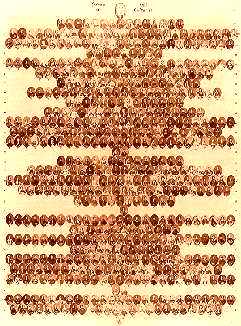
Henry Jones took nine years to complete his mosaic of the old lady
colonists. In July 1881 the Observer reported, ‘We had an opportunity
of inspecting a group of portraits of old lady colonists. Mr H. Jones, of
Wakefield Street, who is the possessor of the group, has been nearly ten years in
producing the whole, having taken the first in June 1872. The portraits, which form a
companion group to that completed some years ago of the old gentleman colonists, have all
been taken from life, and this fact naturally makes them more valuable. There are
altogether 656 of them, and having been well taken they will be readily recognised by
those who were acquainted with the originals.’
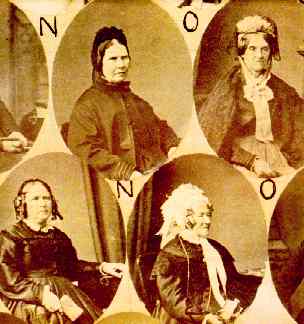
| Below: Henry Jones took nine years to complete this
mosaic of South Australian lady old colonists. While the Observer
item (above) refers to 656 portraits in the group, a recent count made the number of
portraits almost 700, so that more must have been added after 1881. The mosaic measures
approximately 4 ft. 2 in. x 3 ft. 1 in. |
 |
 |
A mosaic made by the Melbourne Photographic Company was mentioned in 1876. It was
presented to the President of the Sunday Afternoon Young Men’s Bible
Class at the Flinders Street Baptist Church and consisted of the portraits of 39 members
of the class arranged in the form of a cross with a cabinet size portrait of their leader,
Mr Joseph Ferguson, in the centre. The picture measured 42 x 24 inches and
included some flowers and scroll work with a place for the names of the class.
Another mosaic ofold colonists was started by W.H. Hammer in 1886, fifty years
after the foundation of South Australia, but it is not known if it was completed. A report said, ‘Mr Hammer is busily engaged with the portraits of the
pioneers, and has found it necessary to confine himself to those who came to South
Austalia during the first ten years, as the demand on his time is so great. In many cases
he received photos which can be returned afterwards. He proposes to have a large panel
with the earliest leading colonists in the centre, and the others grouped round according
to the chronological order in which they arrived. Appended to each photo will be the name
of the individual. The whole will form an exceedingly interesting historical
exhibit.’
In 1890 Thomas Adcock, who advertised as the "Parliamentary
Photographer," arranged the portraits of 52 members of the House of Assembly in a
group around the Premier and the Speaker.
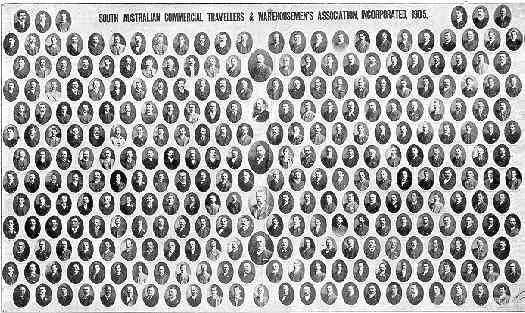
Below: "South Australian Commercial Travellers’ and Warehousemen’s Association
Incorporated, 1905."
A large mosaic of 288 members of the association assembled by Fruhling’s
Studio, Adelaide, in 1905 and mounted in an 11 ft. 6 in. by
7 ft. 6 in. oak frame by D. Bernard & Co. |
|
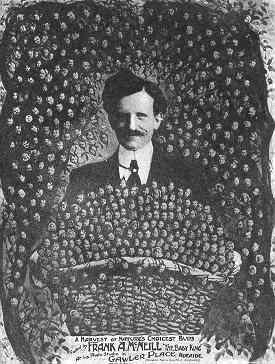
|
Left: "A Harvest of
Nature's Choice Buds Culled by Frank A. McNeill, the Baby King at his Photo Studio in
Gawler Place, Adelaide, (between Harris Scarfe’s and Simpson’s)." Reproduced in the Australian Photo-Review for
November 1913. |
End.