The EYE REST.
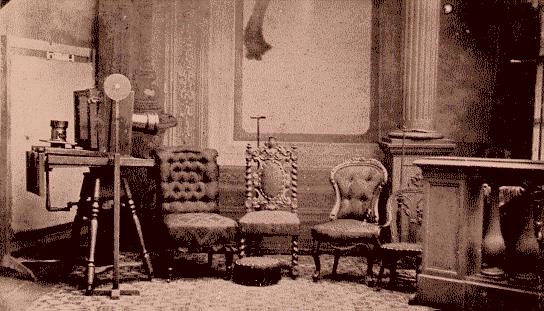
Below: Edmund Diederich's studio at Hamburg, Germany, before he came to South Australia. An eyerest can be seen standing in front of the camera at the left. (Text continues below photograph of studio)
Just as the head rest was used to prevent the head moving during the long exposures required in early portrait photography, so was the eye rest used to prevent the eyes from wandering around the studio while the picture was being taken. If the eyes moved during the exposure the result was usually a pair of eyes without pupils which was sometimes corrected by placing a small dot of colour in the eye to simulate a pupil on the finished photograph. Where a carte de visite has faded a little with the passage of time these dots often appear as a dark grey or black pupil on a sepia portrait.
Sometimes sitters would be told to fix their eyes on a particular object in the studio until the lens had been re-capped. When referring to eye rests one writer has said ‘small pictures on adjustable stands might be used to give the sitter a point at which to look, to reduce eye movement during the exposure.’ In 1864 Marcus Root wrote, ‘A small screen, fixed upon a stand-rod with thumb-screw, movable and elevatable, green or dark in colour, on which some object is placed for the subject to look at, will be found more agreeable to the eyes than a screen of any other reflective colour, or a pin or spot upon the wall or other object.’
|
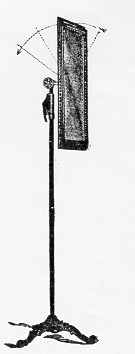
Left: The Baker & Rouse (Australian) "Catalogue of Up-to-Date
Photographic Material" for 1901 advertised their "Studio" brand of eye
rest. It was described as ‘a handsome framed mirror on a stand (which is) adjustable
to various heights and angles. It saves re-sittings. It pleases sitters, making them feel
at ease. It enables the sitter to assume that expression most satisfactory to them,
thereby ensuring a more natural photograph. Prices -- Size No.1 -- Fitted with mirror 14 x 10 inches in plain, polished oak frame, £1 15s 6d. Size No.1 -- Fitted with mirror 17 x 10 inches in fancy, polished oak frame, £2 0s 0d.’ |
End.