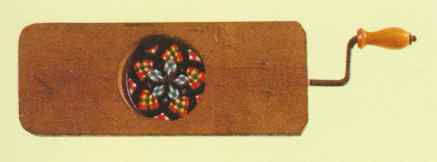
| Below: The
Chromatrope.
|
Lantern Slides.
THIS PAGE IS STILL UNDER CONSTRUCTION.
| Below: The
Chromatrope.
|
Below: The "Man Eating Rats" mechanical slide was considered a classic and was produced in various designs. The main glass slide was stationary and depicted a man asleep in bed with his mouth open. By turning the handle at the right a second circular glass slide with a continuous circle of rats drawn on it was rotated to create the impression that rats were leaping off the bed into the man’s mouth. Moving the lever at the left up and down moved a third glass which made the man’s jaw move so that he appeared to be eating the rats. Mr William Lillywhite screened the "ratcatcher" slide during his lantern exhibitions in Adelaide in 1853.
|
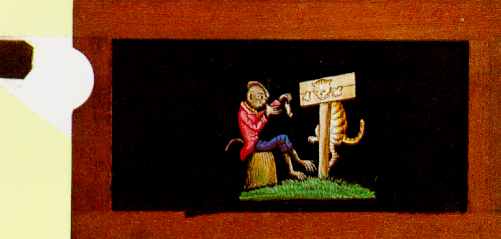
| Below: A mechanical slide
in which the lantern operator moved the glass lever at the left a short distance up and
down to create the effect of a monkey teasing a cat with a mouse. Moving the lever makes
the monkey’s hand and dangling mouse move in front of the poor
cat’s face. Mechanical slides like this were always popular
with children.
|
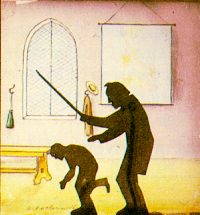
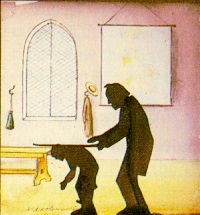
| Below: Two pictures showing the effect produced when the lever is moved in a lever-type mechanical slide. On the left the slide can be seen with the lever in one position, and then on the right the picture seen when the lever is depressed, bringing the cane down on the naughty boy’s back. By repeatedly pressing the lever the master can be made to give the boy quite a beating, one of the boy’s legs moving up and down with every painful stroke of the cane. |
 |
 |
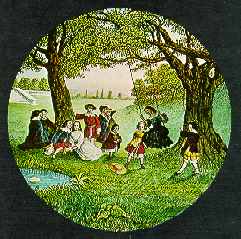 |
Left: A mechanical slide in which the operator could move a lever and give a realistic to and fro motion to the girl on the swing. |
 |
 |
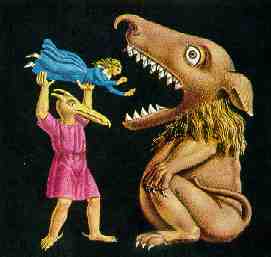 |
Left: A mechanical slide of the late 1700s in which the the long-billed demon at the left seems to be throwing the beautiful maiden into the hungry dragon’s mouth. |
| Below: Long
horizontal glass slides contained a number of images which were projected separately. Such
slides were usually accompanied by a story told by the lanternist who would move the slide
sideways from one image to another as the story progressed.
|
End.