 |
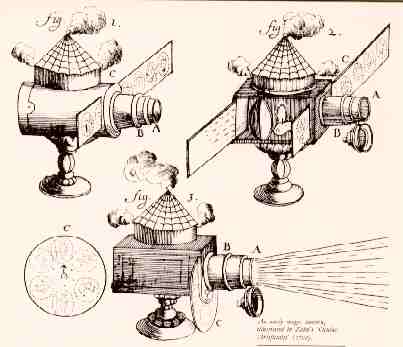
Left: The magic lantern 300 years ago. Note
the smoke coming out of the top of the lamp housings, a problem with the early types
of oil lamp. From Zahn's Oculus Artificialis (1702) |
The Lanterns.
THIS PAGE IS STILL UNDER CONSTRUCTION
|
Left: The magic lantern 300 years ago. Note
the smoke coming out of the top of the lamp housings, a problem with the early types
of oil lamp. From Zahn's Oculus Artificialis (1702) |
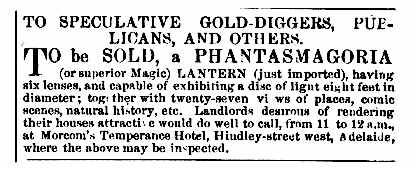 |
Left: Advert. for a ‘superior’
magic lantern. South Australian Register, 21 October 1853. |
In June 1866 Bernard Goode advertised: ‘A Safe Investment -- To hawkers, photographers and others. Just received, per Beatrice, a first-class dissolving view apparatus, with the best set of slides in the colony, consisting of views of London and other parts of Europe, moonlight scenes, moving figures, comic slides, chromatropes, with Adieu and Goodnight in the centre, etc. They would be a good speculation for a person travelling in the country. The whole, packed in a box, for £30. Apply to B. Goode, Photographer and Importer, 69 Rundle Street. Several very good magic lanterns also on sale, with slides and all complete, from 12 to 50 shillings each.’ In 1869 Goode was letting out a lantern with slides for ‘from 20 shillings per night.’
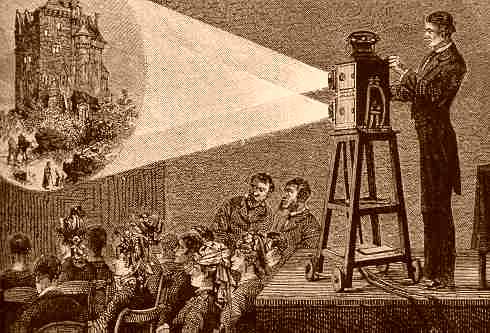
| Below: A biunial lantern. By projecting two slides that were correctly registered on the sheet the lanternist could produce various dissolving effects. In this illustration he is projecting the image of the castle with one lens and with the other lens he is projecting the lights in the castle windows. By dimming or brightening the light in his lantern he can create the effect of the lights in the castle coming on or going off. The artist who drew the picture has pushed artistic licence to the limit. The lantern is pointing towards a corner of the room but still manages to show the slides on the wall at the left, and the ladies in the front row of seats are looking at the slides while those in the back row are enjoying a view further to the left. |
 |
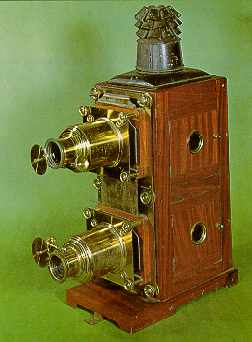 |
Left: Mahogany and brass bi-unial magic lantern without the slide carriers. |
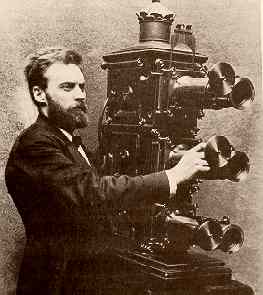 |
Left: A triumph of late-Victorian (?) craftsmanship -- a tri-unial lantern. |
|
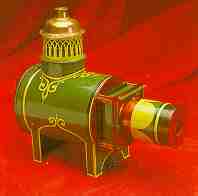
Left: Even little toy lanterns were highly decorated in the 19th century. |
The Kaleidographe.
When a reporter for the Observer paid a visit to the Adelaide Childrens’
Hospital in January 1880 he noted, ‘I was shown an instrument known as
Pritchard’s Kaleidographe. In appearance this somewhat resembles the apparatus of a
magic lantern and is, as its name implies, a modification of the kaleidoscope.This
instrument was very kindly presented to the institution by Mr T.D. Smeaton, Manager of the
Bank of South Australia, and will probably be the source of many hours’ amusement to
the poor stricken fledglings of society, to whom this Hospital is at the same time a
hospital and a home.’
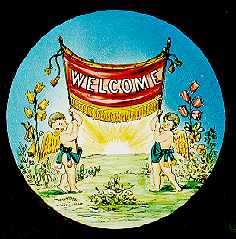
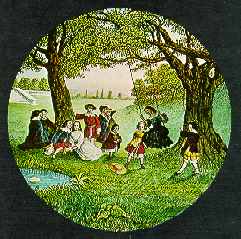
Below: Two painted magic lantern "sliders".


Below: Two hand-painted magic lantern slides.
 |
 |
End.