KAPUNDA PHOTOGRAPHIC CLUB
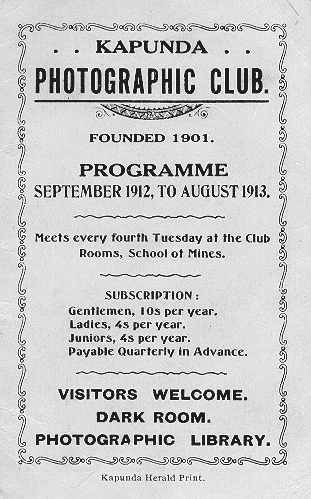
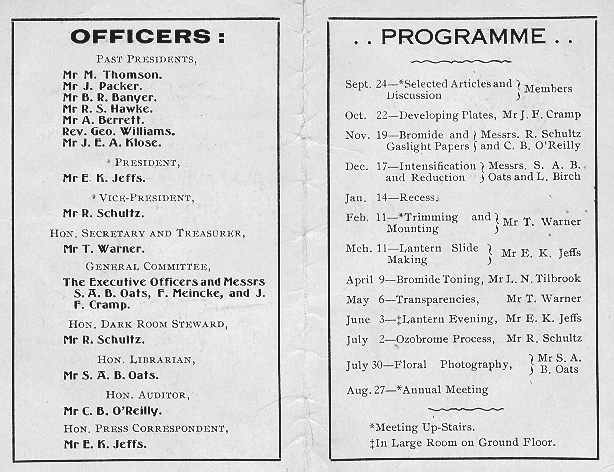
Note: There is a copy of the Club’s 1912-13 programme at the end of this file.
In June 1901 a group of amateur photographers.formed the Kapunda Photographic Club and elected the following officers: President, Mr M. Thomson; secretary, Mr T. Warner; committee, Messrs R.S. Hawke, F. Meinke and W. Gropler. The stated objects of the club were ‘the exchange of photographs, interchange of suggestions and experiences relating to photography, the formation and maintenance of a photographic library, the promotion of a closer acquaintance among photographers in this and other states, and photographic excursions’, and it was hoped that it would be possible to ‘bring the amateurs of Angaston, Tanunda, Tarlee and Eudunda in touch with the club.’
Although fortnightly meetings were originally intended to be a means of helping beginners during the first half-year, the annual report for 1910 stated that ‘as in previous years, a fixed programme of fortnightly demonstrations’ had been carried out. Club rooms were established in Hill Street and by August 1901 it was reported that the club was doing ‘splendid work’ and that the number of members was ‘far larger than expected.’ The club was well represented in the large photography section of the Kapunda Agricultural Show held in September 1901 which was judged by Adelaide professional photographers Ernest Gall and S.P. Bond.
In January 1902 a competition was held with the lower dam between Hill and Coghill Streets as the subject. Residents living near the dam were told that they should not be alarmed by a sudden influx of visitors to the area ‘at rising, midday, and afternoon suns.’ Judging was carried out on a points system with handicap points awarded to ‘as near as possible equalise the chances of old and new members.’ The prints entered in the competition were constructively criticised by Mr White of Baker and Rouse at a special meeting of the club.
Ernest Gall assisted the members of the Kapunda Photographic Club (q.v.) in their formative years. He gave valuable advice on how to form the club and acted as a judge and critic of their comnpetitions. After he judged the club’s portraiture competition in July 1902 and a report stated that he ‘accompanied his awards with a detailed criticism of every picture. His standard was high, but not by any means beyond the attainment, and certainly not above the ambition, of enthusiastic members, and while his criticisms were trenchant they were not in the least hypercritical, and formed a very valuable lesson to the competitors. The club is greatly indebted to Mr Gall for the trouble he went to to make the competition a useful lesson in the art of photography.’ Several members expressed ‘their delight at the thorough and instructive criticism of their pictures and the happy manner in which faults were pointed out and remedies suggested.’
At the 1902 Kapunda Show club members accounted for all of the 170 entries in the photography section, no competition being received from ouside the club. The judge. Mr H.H. Wight of Baker and Rouse, reported that the pictures exhibited were ‘highly creditable, and considering the few facilities in the country, the exhibition compared more than favourably with the recent exhibition in the city.’
The Kapunda Photographic Club held its first exhibition at the Kapunda School of Mines in January 1903 where ‘all the best workers [in the State] were represented, almost every known process of production was demonstrated, and the pictures ranged in in dimensions from an inch or two inches square to life-like proportions.’ The exhibition was an outstanding success and its two objectives were achieved. One was to ‘enable the members to be brought in touch with a higher class of work than they were lkikely to otherwise see in Kapunda’, and the other was to ‘enable residents of Kapunda to see a branch of photography that was not to be found in ordinary trade pictures. The expense of their production was too high for general trade purposes.’
Non-competitive exhibits were received from E. Gall, C. Radcliffe, C.L. Whitham, H. Ashworth, W. Andrew, J. Kauffmann, A.H. Kingsborough, Andrew Scott, A.W. Dobbie, Douglas Scott, S. Smeaton, and E. Stokes. Dr H.H. Norman exhibited colour stereographs and ‘colour transparencies for placing in a window’ and W.S. Wedd exhibited ordinary stereoscopic pictures. Exhibitors in the Open competitive section included F.C. Joyner, Mrs (Dr) Jay, Miss Kingsborough, E.W. Belcher, A.E. Ayers, W.D. Clare, F. Gabriel, C.L. Whitham, and C.F. Rainsford. A separate section was reserved for members of the Kapunda Photographic Club.
Adelaide photographic equipment supplier S.P. Bond sent eight sepia-platinotype views made by one of England’s leading pictorial photographers, the late H.P. Robinson and a photograph by Mr David Blount, ‘Daughter of Eve’, which had won several gold medals and had been ‘most highly spoken of by critics in England and Australia.’
The exhibition ran for several days and in the evenings lantern slides were shown in a large room at the rear of the premises where a powerful acetylene gas lantern was operated by Mr W.M. Shakespeare of Adelaide.
In December 1902 the instructor in art at the Kapunda School of Mines, Mr S.H. James, gave a lecture on Pictorial Composition, describing it from the painter-artist’s point of view and then explained its application to photography. Mr James also assisted with the club’s exhibition, supervising the grouping and hanging of the photographs, and in appreciation of his assistance the club made him an honorary member. In April 1903 the club’s meetings were transferred to a room at the School of Mines.
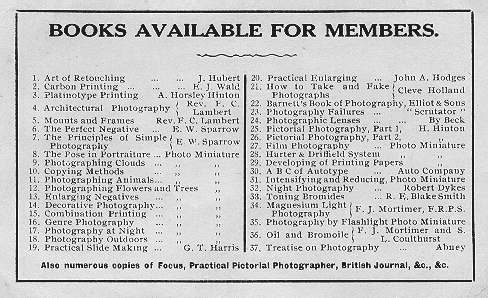
At the third annual meeting held in July 1904 the president reported that in the past year the membership had doubled and was now 33, which probably included the junior members. Several competitions had been held, photographs and lantern slides had been sent to exhibitions connected with the Mount Gambier and Port Pirie photographic societies, and practical demonstrations had included developing all kinds of plates, making lantern slides by contact and reduction, toning bromides, carbon process, toning printing out paper by gold and platinum, postcard work, flashlight photography, and enlarging negatives. In 1905 the club established a library of photographic books with Mr M. Thomson as librarian.
A total of 110 pictures were hung in the photography section of the Kapunda Agricultural Show in September 1904, most of it the work of members of the Kapunda club. One of the reasons for the club’s dominance was the rule that all photographs had to be taken within 35 miles of Kapunda, a restriction that was expected to be removed the following year.
At the Art and Industrial Exhibition held at Kapunda in October 1905 the photography section was ‘by far the largest and most attractive exhibit.’ Photographs were received from amateurs at Broken Hill, Mount Gambier, Gawler, Port Adelaide, and the Adelaide Camera Club, a total of 265 picture, 125 local and 140 from outside the district. The judge was leading Adelaide pictorial photographer John Kauffmann (q.v.) who ‘expressed surprise at the all-round excellence of the pictures and the large display which would in certain classes hold its own against city work, whilst some others showed much promise, and his remarks applied to the junior work as well as to the senior.’ The most successful exhibitor of prints was Thomas Warner of the Kapunda club, and when the 60 lantern slides were judged Warner was awarded first prize.
John Kauffmann judged another competition at Kapunda in May 1907 and travelled to Kapunda in search of subjects for his camera (see under WARNER Miss Dorothy). He became a member of the Kapunda club, probably in an honorary capacity, and his assistance was acknowledged at the club’s meeting in October 1907, where the president referred to ‘the success of Mr J. Kauffmann, a member of the club, who had three pictures accepted by the Royal [Photographic] Society of London.’ In response to remarks about the success of Kapunda amateurs at recent exhibitions the secretary, Thomas Warner, said that ‘whatever success his daughter or members of the club had achieved in pictorial photography, was mainly due to the great assistance rendered by Mr Kauffmann. Last year we had the pleasure of congratulating Mr Kauffmann on getting two of his pictures accepted by the London Royal; but this year he has gone one better, and we are delighted to hear that three examples of his work have found their place on the walls of the Royal… two [of the] pictures accepted were "The Lonely Cottage" and "The Brow of the Hill"… views of Baker’s Flat, Kapunda. That the club send its hearty congratulations to Mr Kauffmann (who is on a visit to Victoria) was unanimously agreed to.’
A valuable club member was lost when B.R. Banyer (q.v.) left Kapunda for Balaklava in 1910 and over the next few years further transfers from the town gradually eroded the club’s existing and potential membership. In December 1914 it was reported that although the club was financially sound its membership was small, and it was noted that the club’s one and only secretary, Thomas Warner, had only missed one meeting in 13 years, a remarkable record considering that for most of the time the club had been meeting fortnightly. The club appears to have dissolved during World War I when most of the younger members joined the armed forces leaving only a few older members to carry on.
End.